Tuesday, August 17, 2010

Rocky Mountain Riding

Blue skies and sunshine but the technician in the bike shop tells us the trails will be hard work from the previous night's rain storm and will cake the tires with red Colorado mud. We are better off waiting until the afternoon when the sun has had a chance to dry the trails.

So, instead, we visit the Durango Fish Hatchery. We are the first visitors of the day and the volunteer museum guide is keen to give us all the information about the fish found locally, particularly trout. We also view an exhibit of stuffed animals. One is a black bear that was involved in a car accident two years previously. The bear stands over 6 foot high and weighed 400 pounds. Our guide tells stories of a bear that spent a day sitting in the tree outside the museum last summer and a mountain lion that took a dog from the house next door.

We wander outside to view the raceways that contain thousands of trout ranging from very small to quite large. From these raceways a million trout are put into the rivers and reservoirs of Colorado each year.

After an early packed lunch, eaten from the back of the car, we go to pick up our mountain bikes and set off for an afternoon's riding from the shop. We use a paved biking path to get to and cross the Animas River. Immediately after crossing the river we leave the paved path to take a trail up the hillside. Phoebe falls off her bike as we leave the path. She is not hurt. The trail is muddy, rocky, steep and narrow. The undergrowth scratches our legs and arms. Max, George and Colin seem to have no problem making the ascent. Phoebe and Rachel find it very difficult. They walk most of the way up the trail. By now it is hot and the sun is strong. The altitude makes the climb strenuous.

Eventually we come to a road. We decide that paved surfaces are perhaps better for a while and return to the river path. Towards the centre of Durango we try another mountain biking area, this time the trail  is a wide but rocky unpaved road. Rachel and Phoebe decide to proceed at their own pace, which turns out to only be a few metres. Colin, George and Max ride off making the slow ascent on the road called Horse Gulch. It seems popular with locals who obviously do not have any problem with the altitude or rocky surfaces.

When Colin and the boys return we decide to continue our biking by taking different routes, aiming to meet at a point where trail and paved river path join. Colin and Max take the trail while Rachel, Phoebe and George take the paved path. We never meet. Somehow we pass each other at the water treatment works, cycling on different sides of the works. Rachel, Phoebe and George wait for nearly an hour at the designated meeting point. None of them have cell phones. Colin is the only one carrying his phone. Eventually Rachel decides to ask people she meets if she can use their cell phone to call Colin. She imagines an accident has delayed him and Max. The first four people do not have phones. They are returning from a rafting trip on the river. Eventually a woman walking a dog has a phone. The dog is wearing a coat from the animal humane society that says "adopt me". George and Phoebe make a fuss of the dog while Rachel discovers that Colin and Max have been searching for them! They have been cycling to and fro on the path trying to find the other half of their family!

A soak in the hotel hot tub helps aching knees and legs. Tonight we discover a Mexican Taquaria - a fast food Mexican restaurant. We join the queue of people. The food is freshly cooked as we wait in line. It is fabulous - and reasonable. Phoebe makes the best choice - fish tacos - battered fish freshly cooked served in small flour tortillas with chopped tomato and Mexican tartar sauce. We all sample it - delicious.

Monday, August 16, 2010

Cliff Notes


We wake to hear rain on the tin roof of our cabin. It has stopped by the time we get up. Phoebe, George and Max's shoes are very muddy as they go for one last visit to see the sheep, goats and llama. We pack the car and leave Bayfield for Durango. 

As the weather forecast is cloud, rain and thunderstorms we decide to change our plans for the day. Instead of mountain biking we will visit Mesa Verde National Park, just west of Durango. Mesa Verde contains the remains of homes and cliff dwellings of the Ancient Puebloans. 

In the distance we can see the Mesa of Mesa Verde, a stark cliff face like a jutting chin. After driving along a fairly flat valley, we entered Mesa Verde National Park and began a 12 mile winding ascent to the top of the Mesa. The views as the road climbs are fantastic. We can see far into the distance. It's like the view from an airplane window.  Our first stop is the visitor's centre to buy tickets. It is windy and quite cool at the visitor's centre. The wind whips up the valley to the Mesa top where we are waiting in line to buy tickets. Tickets are required for viewing the cliff dwellings with a park ranger as a guide. We choose to visit Long House. This is the most remote cliff dwelling. The tour begins at mid-day. As it was already 11:15 we hurry as we have a 40 minute drive across the Mesa top to our destination.

Our group is small, around 20 people instead of the normal 50 people. The cliff dwellings are beneath the Mesa top, over the cliff edge, built in a natural ampitheatre in the sandstone. Although our walk down the cliff is on a paved path with steps to the cliff dwellings, the ancient cliff dwellers scrambled up and down the cliff using toe and hand holds. The drop to the valley bottom is long, down sheer cliffs. It is frightening to think how these people made such a climb. 

Built in 1200AD, the remains of the houses in the cliffs that we walk around were the choice of around 100 people. Women, men and children lived in this strange ampitheatre instead of living on the Mesa top. Our ranger points out that during this time, in contrast to the primitive lifestyle we see, Notre Dame was being built in Europe.

After our tour, we decide to explore other dwellings on the Mesa top before heading back to the car. A tram car takes us and a few other people back to the car park. On the way we see wild horses, but no mountain lions that also live in this area.

By now it is mid afternoon. The weather has improved and it is hot and sunny. We drive to the other more popular cliff dwelling but by now we are tired and decide to cut short our visit, only visiting the museum. It is hot and busy and driving on the winding roads is nauseous.

Driving back to Durango we see black clouds. Lightening flashes ahead of us and as we draw nearer to Durango, and the hills surrounding the town, we see a thin covering of snow that has just fallen during the storm. We run into our hotel just as it begins to pour with rain. Suddenly the windows are rattling as rain turns to hail. As we go to find a restaurant for dinner, piles of hail stones litter the pavements. Tourists and locals in flip flops and shorts slap their way along the street.

Sunday, August 15, 2010

Off the Grid

Sunday, 15 August

George is up early this morning at 6am. There is no television to watch! Instead, he dresses and goes to visit the sheep, goats and llama. Max and Phoebe followed a little while later. Consequently, our usual early morning start is not so early. Our aim for the day is to hike near Vallecito Lake. The owners of the farm where we are staying are able to direct us to one of their favourite hikes. We drive to trailhead and are surprised to see the car park full with cars and horse boxes. We speculate that many have probably chosen to stay overnight, as it is the weekend, in the Weminuche Wilderness that can be accessed from this trail.


The sun is strong in the thin mountain air. The trail begins in a valley, but we have already climbed in elevation on our drive to the trailhead. The bottom of the valley is flat with a broad meadow dotted with pine trees, owned and fenced in by Granite Peaks Ranch. The sides of the valley rise steeply as granite cliffs, standing majestic against the deep blue sky.


We cover exposed skin with sun cream, fill camelbaks with water, pack our picnic lunch and begin our hike. The beginning of the hike takes us through a gate displaying the Ranch name and a notice warning that leaving this area with horses or cattle that do not belong to you is theft. The start of the trail is littered with fresh horse manure. We are thankful for the trees which give shade from the sun.

Our progress is slow. This is an "in/out" trail and we are not sure how far we will hike. The trail can take us to Emerald lake high above the valley but this is 10 miles and the last four 4 miles are a steep climb. Having hiked at this altitude before we know that just to get to the lake will take us around 4 hours.

After about two miles of walking we come to a creek that flows across the trail. Although it is easy to cross, using rocks that are above the water as stepping stones, we stop for a few minutes to enjoy the stream. Phoebe chooses to take off her hiking boots and dip her feet in the cold water.

The trail is strewn with rocks and the elevation rises and falls. George is only wearing indoor soccer shoes. He will borrow Colin's spare trail shoes for future hikes.

After about 3 miles and two hours of hiking we enter the Weminuche Wilderness. Even though we have entered the wilderness, the scenery does not change. We encounter a few other people, some walking with their sleeping mats rolled up in their backpacks and some on horses dressed in stetsons and cowboy boots. They carry their packs on a second horse tethered to the first and without a rider. We meet one couple with two llamas who are heading out into the wilderness. The llamas eye us cautiously but are happy to be stroked by George and Max. The llama hair looks so thick it seems impossible that the animals would feel anything. Phoebe looks delighted to see her favourite animal.

A little way into the wilderness we decide to stop and find a place near the river for lunch before we head back. The scenery is beautiful with the refreshing sound of running water and sunlight streaming across the pine covered mountain slopes. Lunch is sliced bread filled with sweating cheese slices and ham from our backpacks. Phoebe and George and Max are able to climb onto rocks in the swlrling water of the river and eat lunch on their little islands. Colin and I sit on the remaining rocks closer to the shore.

From this point on the 3 miles hike back is at a good speed. It is around 1:30pm and the sun is high in the sky. The trail looks completely different in this light and the heat is getting unbearable. We arrive back glad to consume water and Gatorade that we have in the car.

Saturday, August 14, 2010

Spa Treatment

Saturday, 14 August
Today we leave Santa Fe and New Mexico and travel to Bayfield in Colorado. Our route is more or less directly north. As we leave Santa Fe we stock up on supplies, mainly food, for the next two days. Where we will be staying in Bayfield is a long way from any shops or restaurants.

With a breakfast of bagels in the car, we set off. Somehow we lose our way and instead of being on a main highway we find ourselves on a back road. The towns we pass through consist of trailers, static caravans, that serve as people's homes. Eventually we manage to get back to our route. The scenery is stunning with cliffs of different colour rock, sometimes close to the road and sometimes further in the distance. Different sedimentary rock layers can be seen in varying colours of white, red and gray. The landscape is dry and scrubby, only small bushes can be seen for miles in every direction.


Eventually the road begins to climb and the scenery becomes alpine as we enter the foothills of the San Juan Mountains of Colorado. Undulating meadows stretch on each side of the road and mountain tops are in the distance. There is no sign of human habitation. At one point we cross the continental divide. We leave the side of the continent where water and rivers flow into the Atlantic and cross to the side where water and rivers flow into the Pacific. We stop to take a photograph as we leave New Mexico and enter Colorado.


As we begin to descend in altitude, we come to Pagosa Springs. Here we take a break in our journey to soak in the natural hot springs. At this resort the springs have been channelled into over twenty pools of water of differing temperatures. We pay our entrance fee, collect towels, apply sunscreen and swim wear. In between the pools are sun beds, all facing towards the San Juan River on the edge of the resort.

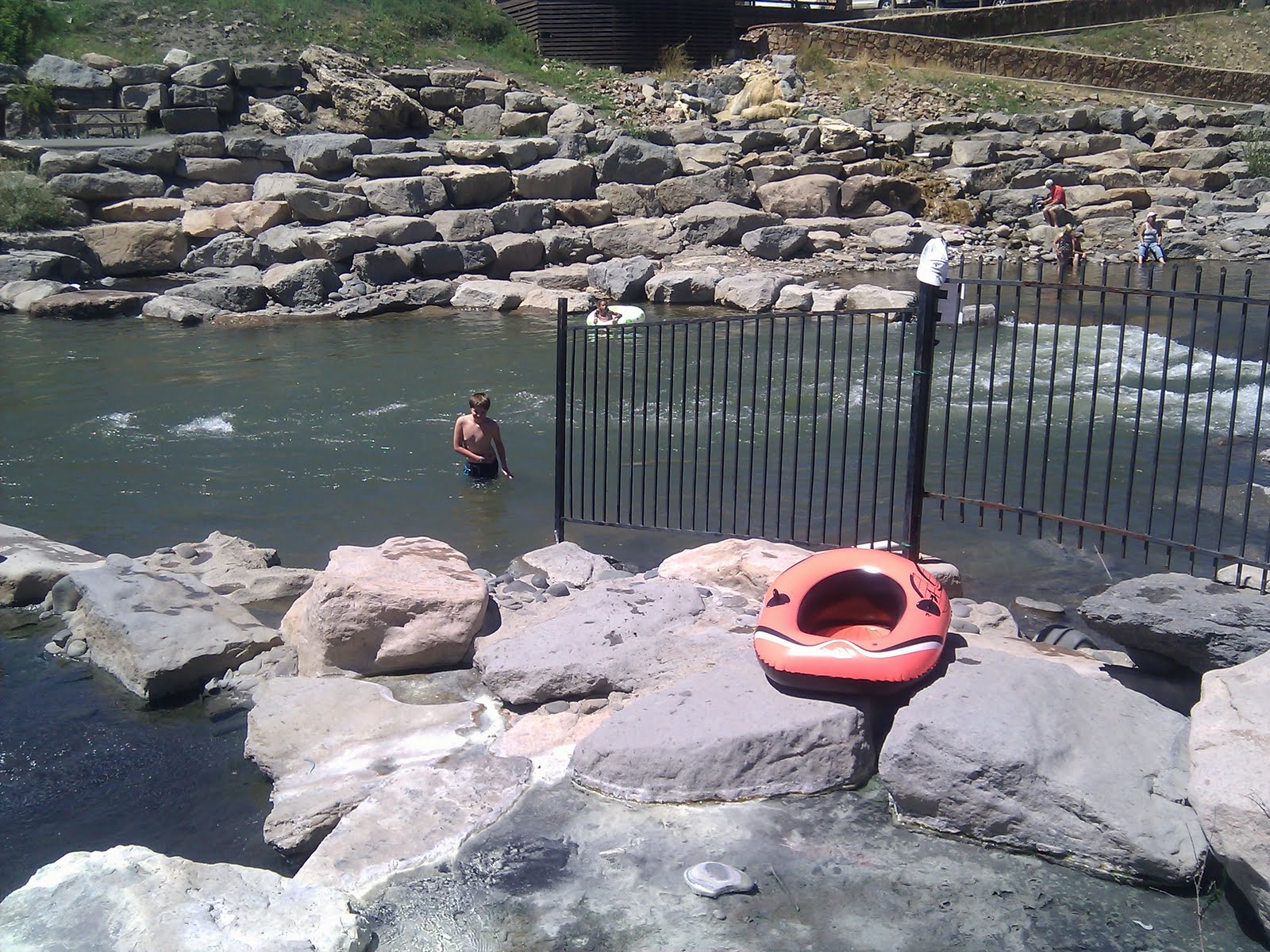
Hot water bubbles up into the pools and excess water flows in channels towards the river. The smell of sulphur is strong. But the minerals in the water are evidently very good for the skin. We start off by soaking in one of the cooler pools that is signposted as being 97 degrees fahrenheit. The water feels warm. We move to pools where the temperature is given as 100 and 107 degrees fahrenheit. The water is nearly unbearable. One pool is 118 degrees fahrenheit but this pool is closed as it is too hot. The sunny weather of 87 degrees seems cool as one exits the pools. George and Max and Phoebe are tempted to go in the river but the water is cold. George's desire to swim in the rapids is greater than cold river water. He decides to join others who are floating down the rapids into the fast flowing river either using tubes or their own bodies. He quickly learns it is important to keep his feet up from the rocky bottom of the river to avoid scraped toes. We watch him from our sun beds.

Bayfield is approximately an hour from Pagosa Springs. Once we reach Bayfield we turn off onto a partly made up road and drive for another 15 miles. Our destination for the next two nights is "de goats 'n' sheep ranch" owned by a couple who raise Wensleydale sheep and goats for their wool and who rent out a cabin on the property. We're not quite sure what to make of it when we arrive, it seems rather ramshackle but the owners are very hospitable. The cabin is immaculate and set at the back of the property against a background of trees and hillside. After unloading the car, we go to meet the animals. Amongst the sheep and goats in a llama. He eyes us from a distance but eventually joins the sheep and goats who have rushed to the fence as we come to look at them and feed them with grass. Some of the sheep are wearing coats to protect their fleece. They are woolly! Even their heads are covered in long shaggy wool so it is difficult to see their eyes.


As dusk arrives, a deer appearing in the clearing near the cabin with others on the hillside behind the cabin. As darkness comes, numerous stars and the Milky Way can be seen in the clear night sky.


Friday, August 13, 2010

South by South-West

The day starts early. We are awake around 5:30am, which is 7:30am eastern time. After lazing in our hotel room for a while we begin the morning by using the hotel pool and hot tub which is open for use at 7am. These are located in an open air courtyard at the centre of the hotel. It is quiet. The majority of hotel guests are still in their beds. A couple of children watch us enviously from the balcony of their room. We hear them asking their parents if they can go to the pool. The answer is "not now". The water in the hot tub feels very hot but it is refreshing. The sun is just beginning to rise over the top of the hotel building and shine into the courtyard. The sky is deep blue against the rust-coloured walls of the hotel.

We head into the historic district of Santa Fe, just a short distance from our hotel. At the centre of this district is the Plaza approached by roads from each corner. As it is early there are only a few people around - those getting coffee and take-out breakfast before work, a few tourists and others who are just sitting in the Plaza. Grass areas with trees, hanging baskets of flowers, paths and benches make up the Plaza. Most of the benches are wet. This is not from overnight rain but from a man with a hose watering the hanging baskets that are directly above the benches. We spend a little time sitting on a stone wall in the centre of the square eating a breakfast of french pastries and baguette bought from a cafe just off the Plaza. The sun's rays are already powerful and hot. We move trying to find shade.

It's not the most exciting way to start a vacation but we decide to do a walking tour of the northern historic district of Santa Fe, using a Frommer's guide, and view the architecture. We keep to the tour, more of less. Most of the buildings are adobe with only one or two stories and rust brown in colour. They look like sand castles. The thick adobe walls are plastered so the surface is smooth and the edges and corners of the buildings are curved instead of pointed. They contrast beautifully with the deep blue sky. Many of the shops are art galleries selling paintings, sculptures and other artwork.


On our stroll we browse the wares of street artisans - Pueblo Indians - selling jewellery. They are set up in a row in the shadow of the portico, or porch, of the seventeenth-century Palace of the Governors, the ancient El Palacio Real, building. The jewellery is set out by each artisan on a square cloth or rug, each rug touching the next so we move quickly from seller to seller as we walk along. The sellers sit behind their rugs, next to each other, sitting on chairs or crates. They point to and pick up their wares to show us using a long stick. Phoebe buys a necklace made out of corn coloured blue from an old man with a very lined face. It is for a friend's birthday but she is quite keen to keep the necklace for herself.


We walk to see the Cathedral Basilica of St. Francis of Assisi off the Plaza enjoying the coolness of the interior. By now the historic town is becoming busy with tourists. We go back to our hotel, pick up some food for lunch and drive to Los Alamos, about an hour and a half from Santa Fe.

As we get closer to Los Alamos, the scenery becomes very dramatic. Gorges cut through the sedimentary rock and display layers of brown and red crumbling rock. The road climbs from the bottom of the gorge to the top of the plateau. We stop for lunch at a pull-out area off the road and admire the view as we eat sandwiches made from sliced bread, ham and cheese purchased in a Santa Fe supermarket.


We have come to Los Alamos to visit the Bradbury Museum. In 1943 the town of Los Alamos was created as a community, not known to anyone outside, of scientists from the USA, Britain and other countries, their spouses and other support staff. The average age of the community was 25. The purpose of this community was to build the atomic bombs that were dropped on Hiroshoma and Nagasaki. The museum gives insight into lives of particular people who came to live in Los Alamos - personal details of their life while there. Models of the two bombs - Little Boy and Fat Man, named after Winston Churchill, are part of the museum. It is a fascinating but sobering visit.


On our way back to Santa Fe we stop at Bandelier National Monument. By now, the middle of the afternoon, it is very hot. We walk on a trail to see some dwellings created by the Ancient Pueblo people in the valley and on the rock face of the canyon. The rock is made from volcanic ash called tuff. It is soft and holes can be seen in the rock. We climb wooden ladders leaning against the canyon wall to peer into the cave-like holes. George and Max enjoy climbing into these caves. Some of the ceilings and walls show evidence of soot from ancient fires. Although the trail in only a little over a mile, it is hard work walking in the sunshine that seems to bake the rock face and ourselves, and at altitude to which we have not yet become accustomed.


We see long strings of red chiles hanging everywhere so we decide to taste Mexican food for our evening meal. It is easy to find the restaurant mentioned in out guide book and not far from our hotel. The restaurant is busy. We experience our first taste of frybread drizzled with honey. Frybread is a deep fried tortilla that looks puffy. Without the honey it is quite plain tasting but with the honey it is delicious.

Monday, November 30, 2009

ContourHD Deals

Great deal on a ContourHD point of view action camera.